
Advertisment

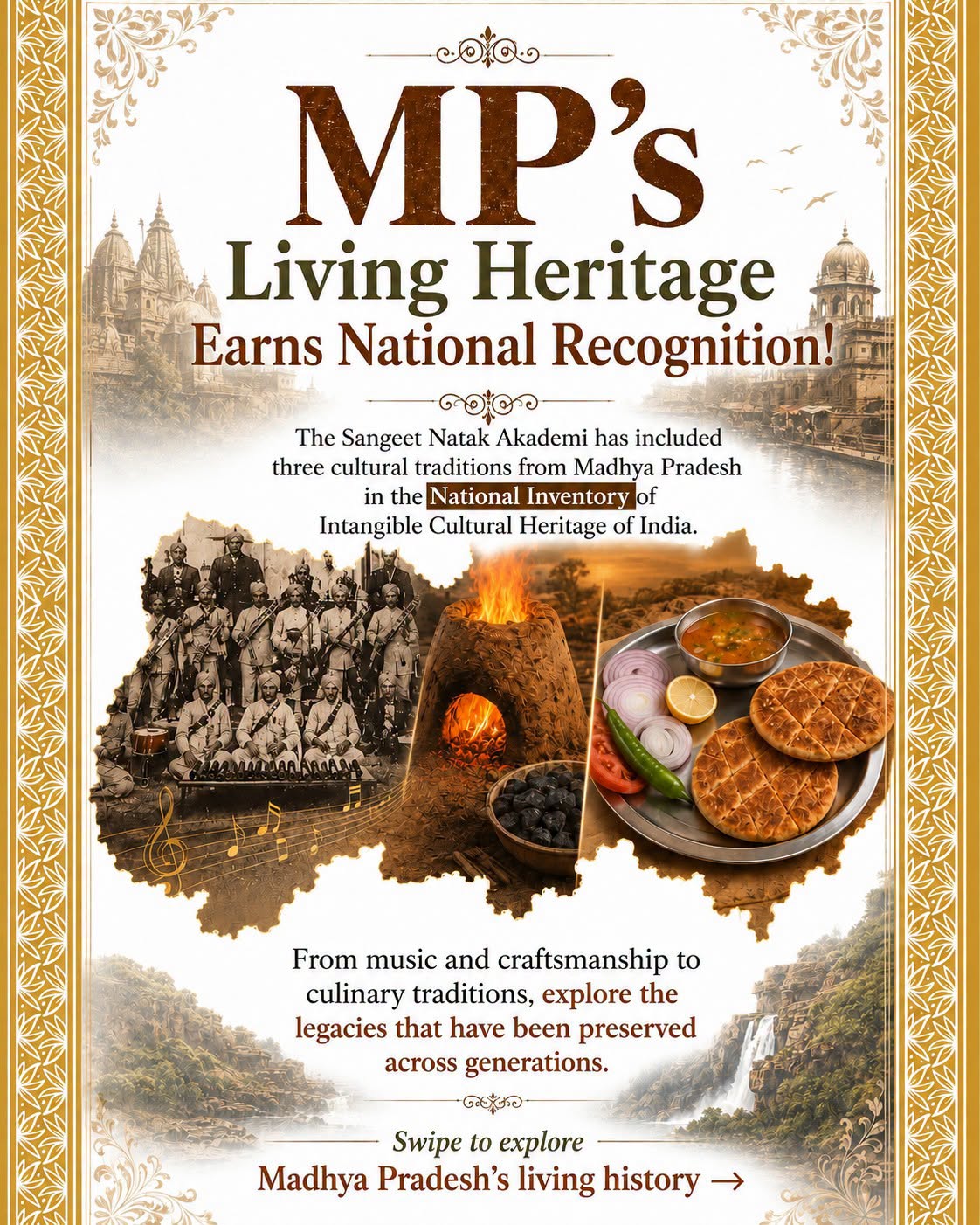
Continued preservation and promotion of Madhya Pradesh’s rich living history on national and international platforms has helped solidify the state’s status as India’s cultural heartland, according to Chief Minister Dr. Mohan Yadav’s vision. The Sangeet Natak Akademi, the government agency responsible for protecting intangible cultural heritage in India, has inscribed three distinctive cultural practices—Maihar Band, traditional iron-smelting techniques of the Agaria community, and Nimari traditional cuisine—into India’s National Inventory of Intangible Cultural Heritage (ICH). This is a major milestone in the preservation of these traditions.
This inclusion solidifies Madhya Pradesh’s bid for future inscription on UNESCO’s Representative List of the Intangible Cultural Heritage of Humanity and is a major step towards gaining worldwide recognition for these traditions.
State Secretary for Tourism and Managing Director of the Madhya Pradesh Tourism Board, Dr. Ilayaraja T., expressed enormous joy for Madhya Pradesh at the inclusion of these three traditions in the National ICH Inventory. The state’s dedication to maintaining its live traditions is further strengthened by this accomplishment. Additionally, Madhya Pradesh’s chances of being added to UNESCO’s permanent Intangible Cultural Heritage list in the future will be enhanced by this acknowledgement.
The award is a tribute to the rich cultural heritage, traditional wisdom, and indigenous practices of Madhya Pradesh, according to Abhay Arvind Bedekar, Additional Managing Director of the state’s tourism board. As he pointed out, the inscription would do double duty: it will promote heritage and cultural tourism in Madhya Pradesh while simultaneously encouraging the preservation of these priceless traditions.
Over many years, the Agaria people have maintained a centuries-old indigenous practice of iron-smelting. Craftspeople still make iron the old-fashioned way, without the use of industrial technology, by heating ore and charcoal in traditional furnaces.
The approach exemplifies a superior grasp of conventional scientific knowledge, sustainable production, and natural resources beyond that of a mere metallurgical process. Using the time-honoured guru-shishya (master-apprentice) model, its methods—which include ore selection, furnace construction, temperature management, and metal refining—are passed down verbally from one generation to the next.
An important part of India’s intangible cultural legacy, this extraordinary body of knowledge attests to the intellectual brilliance and old metallurgical prowess of the country’s tribal groups.
The illustrious Ustad Allauddin Khan, with the support of Maharaja Brijnath Singh Judeo of Maihar, established the Maihar Band in 1918. It is widely recognised as the inaugural Indian classical orchestra in the world.
The group has been around for over a century, and in that time it has produced several talented players while maintaining its distinctive sound. The sitar, sarod, esraj, violin, cello, sitar-banjo, harmonium, and tabla are just a few of the Western and Indian instruments that make up the orchestra’s eclectic sound.
The Nal tarang, a remarkable percussion instrument made by Ustad Allauddin Khan using recycled gun barrels, is its most remarkable feature. No one else in the world plays the Nal tarang like the Maihar Band.
Most Recent






Advertisments