
Advertisment

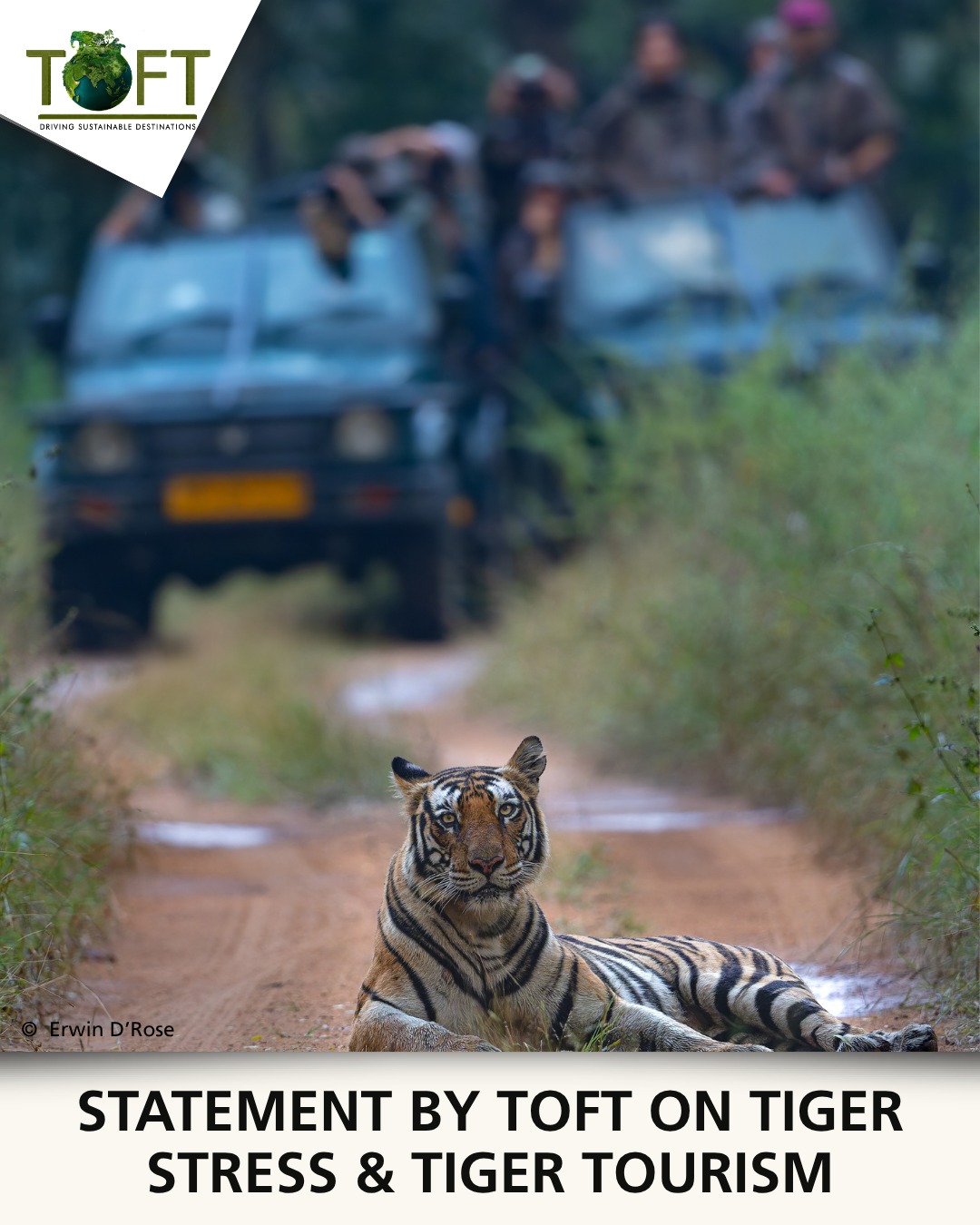
The latest media reporting based on a multi-reserve study by scientists at the CSIR-Centre for Cellular and Molecular Biology (CCMB) highlights that tourism and human activity inside these reserves are significantly increasing stress levels among tigers.
TOFT, who have campaigned in India for the last 20 years for a more sustainable format of nature tourism within tiger bearing landscapes, condemns ANY format of nature-based tourism that places undue stress on wildlife and habitats.
However, TOFT, alongside respected tiger scientists, have put this issue into proper perspective and context, so that undue and unfair criticism does not fall solely on nature-based tourism.
Does nature based tourism help save tigers?
Yes. It has been conclusively proven, that nature-based tourism has been a critical conservation and economic tool – through what TOFT (Travel Operators for Tigers) has termed „Tigernomics‟ – in the globally applauded recovery of tigers across much of India. Over the last two decades the industry has creating vital funds for parks, communities and local government, creating tens of thousands of new jobs and enterprises, catalysing critical infrastructure and new markets in many of the once most marginalised village communities bordering wildlife habitats across India. This industry has allowed tens of millions of principally Indian visitors, but also international travellers, to enjoy and fall in love with these landscapes and their wild tigers, an activity that did not exist till relatively recently.
This new nature-based economy is ensuring that tigers are now seen as far more valuable alive – and seen – than dead and unseen, by both bordering communities and their government agencies – a win-win for tigers.
Is crowding around tigers creating stress?
Yes it can. Tigers – alongside all wildlife – feel stress, whether habituated to human disturbance or not. It is inevitable in all predator prey scenarios, but especially within and between tiger families, and this is true in areas with a high density of tigers – mostly core zones, where tourism exists – where rivalry and territorial disputes are frequent and often. This is a continuous 24-hour social stress.
However, as observed by visitors and researchers alike, numerous tigers and other wildlife are very habituated to tourism – as its predictable and non-threatening – and tigers‟ daily activities, including resting, playing, fighting and even mating, often continue in full view of onlookers.
Furthermore stress is also heightened by the huge numbers of pilgrims visiting shrines, anti-poaching foot patrols, water tankers and forest vehicles, all happening in these same tourism zones, so it is wrong to wholly blame tourism.
Is tourism stress impeding tiger breeding?
No. All empirical evidence would suggest that this stress (high glucocorticoid levels) is not affecting breeding. As Dr Dharmendra Kandal, Tiger ecologist and Director, Tigerwatch in Ranthambhore points out, “Even though Ranthambhore is the most heavily visited park in India, not only hundreds of thousands of visitors but up to 2 million pilgrims every year, three tigresses each raised 3 cubs successfully in 2025/6, in the core areas, suggesting that reproductive success is not affected”.
The graph below highlights this fact with data on the tiger population growth in the park against visitor growth. Ranthambhore was even able to sustain the relocation of numerous tigers to repopulate three other parks in the state.
Such observations are repeated across India‟s most parks, with a famous tigress named Collarwali in Pench Tiger reserve in Madhya Pradesh raising a record 29 cubs, 25 to adulthood, in a well visited area of the park between 2008 and 2018. This suggests again that tourism was not affecting her reproductive success. In fact, these non-threatening „eyes and ears of visitors,‟ were potentially keeping her and her family safe from potential rivals and ensuring a healthier ecosystem and a viable prey base free from poaching and grazing pressures.
A seminal paper in 2012 by Wildlife of India tiger researcher, Dr Aniruddha Majumder, concluded that there was no difference in tiger densities between tourism and no tourism zones in Pench Tiger Reserve, concluding that tigers were not moving (or stopped breeding) because of the tourism activities.
It‟s therefore overly simplistic to say tourism is wholly to blame for these stress levels. Infact ecological pressures, like very high tiger densities, ensures territorial disputes and constant competition with rivals, which operates day and night, is far more likely to lead to constant stress, than the very highly managed and heavily restricted day time visits in all tiger parks today.
Is tourism managed well enough in reserves in India?
Tourism inside parks has been very closely managed and restricted over the last decade by the forest departments and NTCA, given the unrelenting demand for visitations on these parks. Tight regulations, zone controls, strict vehicle numbers and guide use – and now banning of mobile phone cameras – has ensured rules are followed. A central court ruling in 2012 to restrict tourism to only 20% of any given protected area reinforces this action – leaving 80% of tiger landscape free from tourism.
However, what this management has ensured is a „top down one size fits all‟ model of nature tourism within India‟s tiger parks, ensuring too often, an overcrowded experience with tiger sightings, that not ideal for tigers, but is also a degraded experience for visitors. There is zero scope here for a cleverly crafted, habitat and landscape designed and more ecologically sustainable approach, that allows for better experiential formats of nature tourism to be enjoyed, without the „one species wonder‟ dictating every safari drive experience. Far too often, vehicles carrying VIP‟s, especially over key holidays, puts vehicle numbers above full capacity ensuring even greater overcrowding and what looks like distressing images get displayed across social media. This over capacity must be stopped.
However, what has been badly overlooked, is the development of tourism outside of park gates. This has too often been neglected, so the conservation tool that ecotourism could have undoubtably become is undermined. More thought and creative design needs to be done to ensure community integration, ownership and support, together with proper land use planning, critical habitat and buffer zone restoration, important infrastructure development, all to ensure that much of todays over-development and tiger corridor obstructions can be mitigated – or better still, avoided.
Category:
News and Updates
Most Recent






Advertisments