
Advertisment

Saudia, the national flag carrier of Saudi Arabia, recorded significant growth in its operational performance throughout 2025, while continuing to leverage its international flight network to enhance transit traffic yields. The airline transported approximately 37 million guests, reflecting a 6% increase compared to 2024.
During the year, Saudia operated over 203.9 thousand scheduled and additional flights, marking a 4.7% rise, while total flight hours reached around 597 thousand, up by 2.5%.
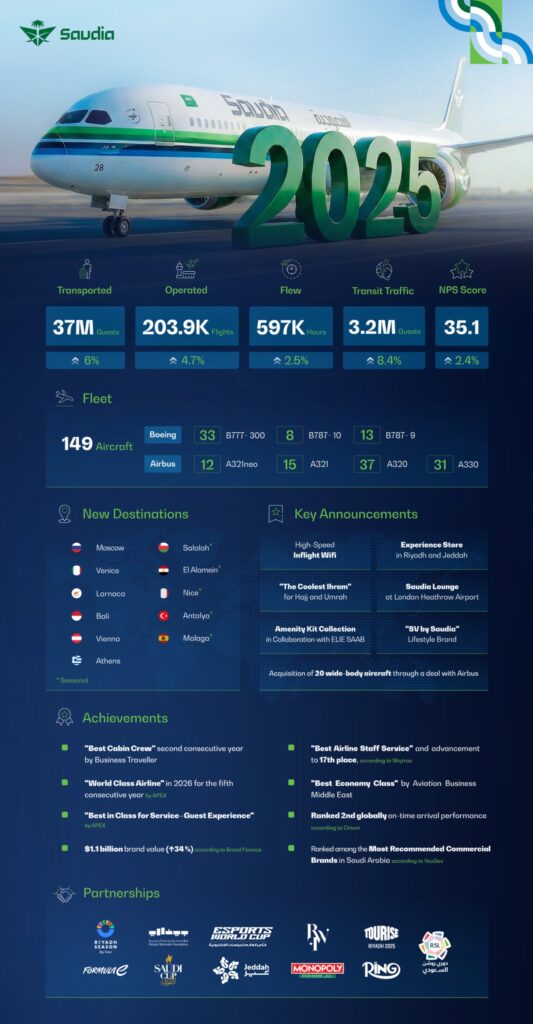
Saudia also continued to record growth in intercontinental transit traffic through airports across the Kingdom during 2025. According to its operational performance report, the airline transported over 3.2 million transit guests, an increase of 8.4%. This growth was supported by year-round operational planning, including peak travel seasons, designed to efficiently accommodate rising demand.
Engr. Ibrahim Al-Omar, Director General of Saudia Group, said: “Our sustained year-on-year growth in the number of guests transported, while maintaining operational efficiency and on-time performance, reflects the integrated efforts of our teams across planning and operations. This performance aligns with the objectives of the Saudi Aviation Strategy and reinforces our role in bringing the world to the Kingdom. Continued growth in our operational performance supports our ability to connect visitors to major tourism, entertainment, and sports events, in addition to the Hajj and Umrah seasons.”
Saudia’s consistent operational growth directly supports the objectives of the National Transport and Logistics Strategy, marked by the expansion of its international network to include key destinations such as Moscow. By launching new scheduled and seasonal routes, the national flag carrier continues to “bring the world to the Kingdom.” This growth is underpinned by innovative service enhancements and industry-leading on-time performance, driving the Kingdom’s ambition to serve 330 million guests and connect Saudi Arabia to over 250 global destinations by 2030.
Tags:
Most Recent






Advertisments

Advertisments
Trending