
Advertisment

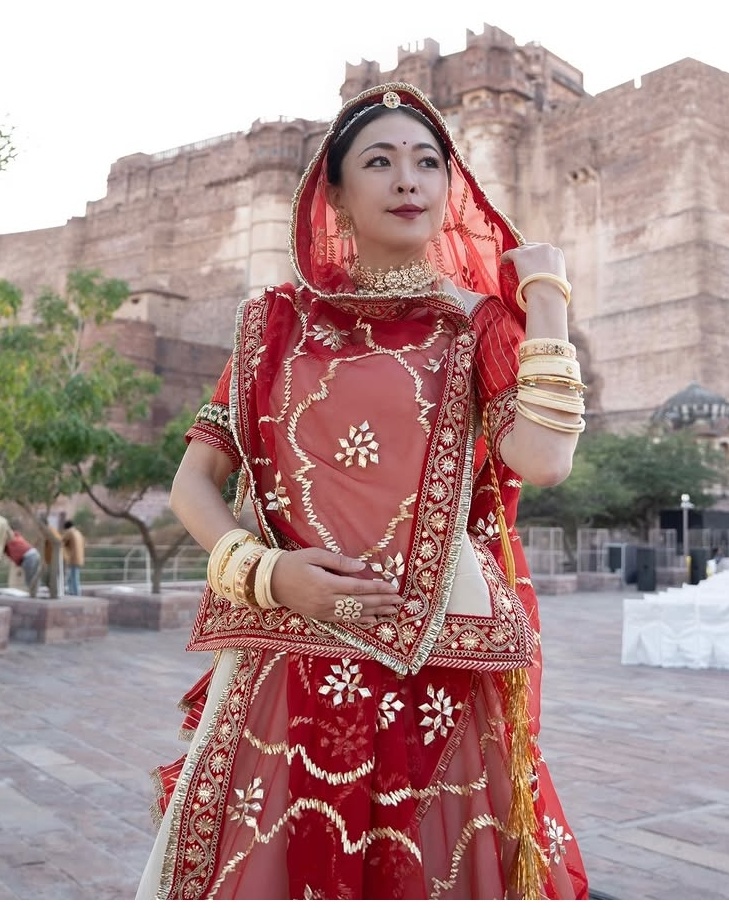
Rajasthan’s appeal to the world extends far beyond its forts, palaces, and sweeping desert vistas. At its heart lies a living folk culture—music, dance, costume, and celebration—that travels effortlessly across oceans and languages. Sometimes, its pull is so profound that it reshapes identity itself.
In Japan, that transformation is embodied by a woman once known as Mayumi, now widely recognized as Rajasthani Madhu.
Her journey is not merely an artistic pursuit but a story of cultural adoption so deep that it altered the way she sees herself and the world. Over the years, her dedication has been acknowledged by the Rajasthan tourism establishment, which has periodically invited her to participate in state fairs and festivals as a cultural ambassador of sorts—someone who carries Rajasthan in her spirit despite being born far from its sands.
Standing amid the vibrant procession of Gangaur in Jaipur—surrounded by swirling leheriya drapes and the cadence of folk melodies—Madhu’s eyes reflect the same wonder she first felt years ago in a Tokyo cinema hall. It was there, watching an Indian film, that she caught her first glimpse of Rajasthan. That fleeting exposure ignited a lifelong fascination.
A self-confessed admirer of Indian cinema, particularly actors Hrithik Roshan and Alia Bhatt, she credits films with opening a window to a culture she now lives every day.
Her first visit to India in 2009 changed everything. Drawn by curiosity about folk dance, she sought out traditional artists in Rajasthan and began learning forms such as Kalbelia, Ghoomar, and Chari. What began as a learner’s interest evolved into disciplined practice. Under the influence of Manganiyar melodies and the guidance of master performers, she came to understand that these dances were not mere physical movements, but expressions of the soul.
Madhu considers herself a disciple of Asha Sapera and regards learning the subtleties of folk singing from Anwar Khan Manganiyar as one of the great privileges of her life. Time spent in Jaisalmer gradually transformed “Mayumi” into “Madhu”—a change that reflected not performance, but belonging.
Today in Tokyo, she runs a beauty salon by day. But as evening falls, her world shifts. Three to four days a week, she teaches Rajasthani dance to Japanese students. In a modest studio filled with colorful odhni, the soft chime of anklets, and the pulse of desert rhythms, Rajasthan comes alive in the heart of Japan.
She admits that building an audience for Rajasthani folk dance in Japan is not easy. There are days when she performs before only a handful of people. Yet encouragement from her students and a growing social media following keeps her committed to the path she chose years ago.
Her bond with Rajasthan runs so deep that she calls it her “second home.” Recognizing this rare devotion, the state’s tourism bodies have, from time to time, invited her to fairs and cultural festivals, where she blends seamlessly into local color despite her foreign origins.
The journey from Mayumi to Rajasthani Madhu is not simply a change of name. It is a testament to the power of folk culture to transcend borders. When music touches the heart, geography becomes irrelevant. One begins to belong to the place where the soul feels at home.
Category:
News and Updates
Most Recent






Advertisments